Science podcast · Radio Istra, Croatia

Under the Stars

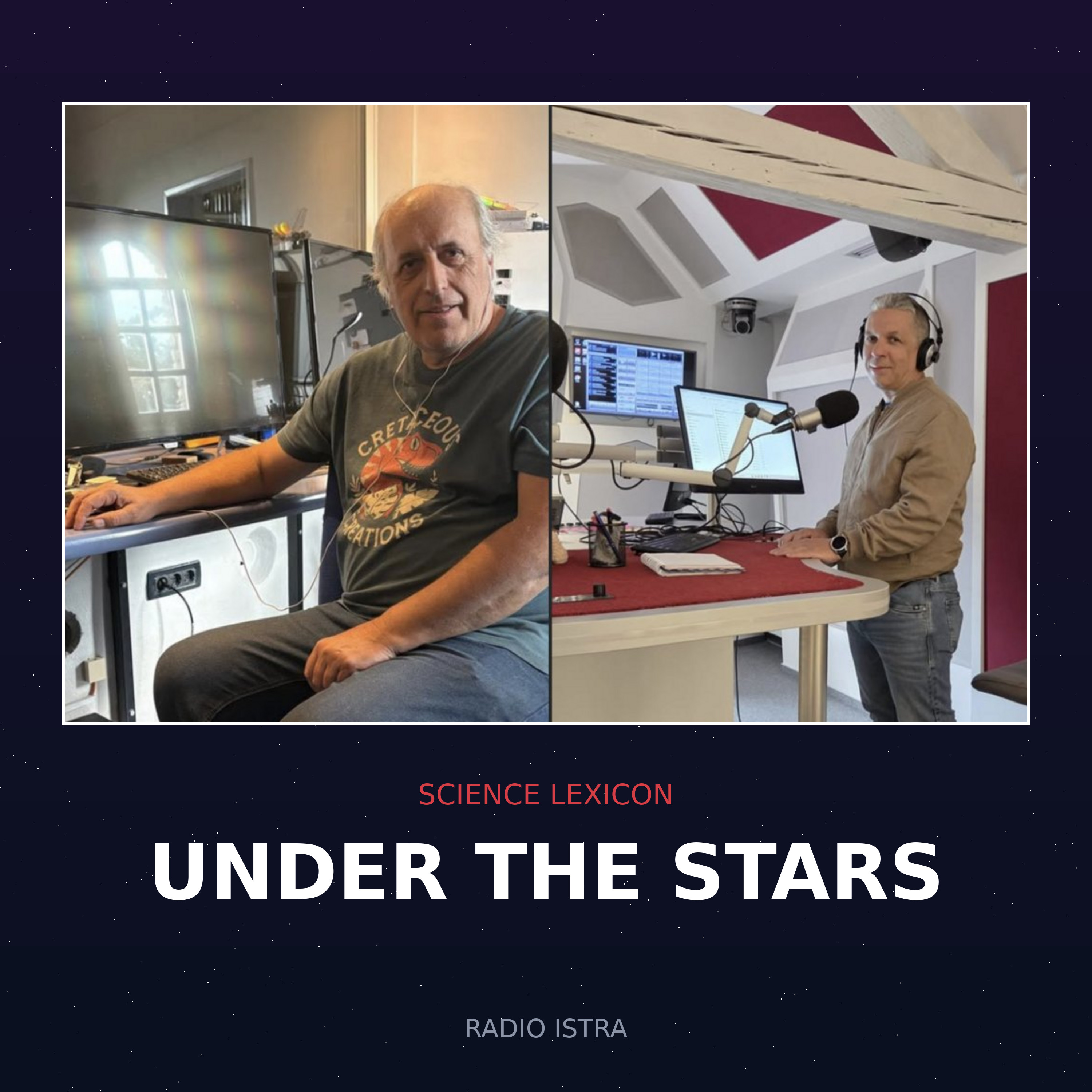
Astronomy and science with Croatian astronomer Korado Korlević and host Ivica Šuran. The English edition of a weekly show from Radio Istra.

Under the Stars — Science with Korado Korlević podcast cover

Latest episode · 18 November 2026

Starship caught by chopsticks successfully lands

26:17

Korado Korlević and Ivica Šuran discuss the successful catch of Starship's booster by the launch tower "chopsticks," comparing it with the failed Vulcan rocket launch that lost forty satellites. They also cover the danger supernovae and gamma radiation pose to Earth's atmosphere, the Hera mission to asteroids Didymos and Dimorphos, the origin of water on Earth, and the possibility of interstellar travel by sending genetic data instead of humans.

  • Starship successfully caught by chopsticks
  • Vulcan rocket launch failure
  • Supernova danger to Earth
  • Hera mission to Didymos and Dimorphos
  • Water origin and interstellar travel

Earlier episodes

  • 7 October 2026 New Starlink Satellites and Space Experiments 23:32

    The episode discussed the launch of a new SpaceX crew and the risks of long-term human spaceflight, along with the new generation of Starlink satellites enabling direct-to-phone communication and the first experimental space-based data centers. It also covered a geomagnetic storm's effects on satellites and Venus's atmosphere, as well as the discovery of the most distant blazar pointed directly at Earth. Special attention was given to the Nobel Prize in Physics awarded for the IceCube neutrino telescope in Antarctica and the discovery of an amoeba surviving in sixty-three-degree water, ending with a discussion on the pointlessness of changing the clocks.

    • Crew launch and Starlink satellites
    • Space-based data centers
    • Geomagnetic storm and Venus
    • Nobel Prize for IceCube telescope
    • Amoeba resistant to extreme heat
  • 30 September 2026 Starship reaches orbital speed with 26 satellites 24:05

    Korado Korlević and Ivica Šuran discuss the SpaceX Starship test flight that for the first time reached orbital speed and deployed twenty-six test satellites, along with issues during the booster's return and a comparison with Boeing's Starliner. They also cover the aging International Space Station, long-duration interplanetary missions like JUICE and BepiColombo, a recently discovered impact crater in Canada, and a new image of dust around an exoplanet.

    • SpaceX Starship test flight
    • Aging International Space Station
    • Long-duration interplanetary missions
    • Impact crater discovery in Canada
    • Exoplanet dust disk image
  • 23 September 2026 The largest fresh crater on the Moon 24:18

    Korado Korlević and Ivica Šuran discussed a recently discovered large fresh crater on the Moon, caused by an impactor roughly the size of a truck, and why such events go unnoticed due to poor telescope coverage for monitoring the Moon. They also talked about computer simulations of the early Solar System suggesting the Sun swallowed a planet five times Earth's mass while others were ejected into the galaxy as rogue planets, as well as exoplanet discoveries and how other systems compare to ours. They also covered space topics such as the Roman telescope and fuel savings at the Lagrange point, the autonomous AstroForge asteroid-mining probe, delays to Starship and Crew-13 launches, and China's intensive space program.

    • New crater on the Moon
    • The Sun and missing planets
    • Exoplanets and similar systems
    • Roman telescope and Lagrange point
    • AstroForge and asteroid mining
  • 16 September 2026 Rapid progress of artificial intelligence and its dangers 21:51

    In Korado's absence, Ivica Šuran and Željko Hrvat discuss artificial intelligence and large language models, their rapid progress over the past six months, and their impact on programming, design, and everyday work. They also touch on darker sides of the technology, such as AI misuse in drones and cyberattacks, copyright issues over the data models are trained on, and the dangers of uncritically relying on AI, for instance in medicine.

    • Progress and capabilities of AI models
    • AI in programming and design
    • AI agents and job automation
    • AI misuse: drones and cyberattacks
    • Copyright and reliability of AI answers
  • 9 September 2026 Coronal mass ejections and Venus's magnetic field 23:23

    Korado Korlević and Ivica Šuran discussed coronal mass ejections and their effects on planetary magnetic fields, particularly on Venus, which lacks a magnetic field and rotates slowly, and the theory that it may once have had a moon. They also covered the use of artificial intelligence in astronomy and software development, the possibility of using lasers to deflect asteroids, and current developments in the space industry — the upcoming Starship flight, China's plans to return Mars samples by 2028, new rocket technologies (Stoke Space, rotating detonation engine), and the first scientific images from the Rubin Observatory.

    • Coronal mass ejections and Venus
    • AI applications in astronomy
    • Laser technology for asteroid deflection
    • Starship flight and space race
    • Rubin Observatory's first images